

PagerDuty Pricing and License Cost: Full Breakdown
PagerDuty's per-user pricing is harder to evaluate than it looks. This guide breaks down every plan, hidden cost, and add-on so you know the real total cost before committing.
PagerDuty Pricing and License Cost: Full Breakdown
PagerDuty does not make its pricing simple to evaluate. The per-user-per-month structure means your costs scale with every engineer you add to the platform. Add-ons, stakeholder licenses, and enterprise features layer on top of the base plan. By the time most teams have fully configured PagerDuty for production use, the actual cost is higher than the headline price suggests.
This guide breaks down PagerDuty's pricing tiers, what is included at each level, what costs extra, and how to calculate the real total cost of ownership for a team of your size. It also covers what you get for the money relative to alternatives, so you can make an informed decision rather than discovering the full cost after you have already committed.
PagerDuty Pricing Tiers Overview
PagerDuty structures its pricing around three main tiers for incident management (listed here at approximate 2025 pricing; verify current rates at pagerduty.com as prices are updated periodically):
| Plan | Price | Target | Key Limitations |
|---|---|---|---|
| Free | $0 (1 user) | Individual evaluation only | Single user, no team use |
| Starter | ~$19/user/month | Small teams, basic on-call | Limited escalation policies, no advanced analytics |
| Business | ~$41/user/month | Mid-size teams, full incident management | No AIOps, limited event intelligence |
| Digital Operations (Enterprise) | Custom (contact sales) | Large enterprises, full platform | Full feature set, custom contract |
All pricing is per full user per month, billed annually. Monthly billing is available at a higher per-user rate. Prices shown are approximate and subject to change; always verify current pricing directly with PagerDuty.
What Each PagerDuty Plan Includes
Free Plan
The free plan is limited to a single user and is designed for individual evaluation, not team use. It includes basic on-call scheduling, alert routing, and the ability to connect one monitoring integration. There is no escalation policy, no multi-user scheduling, and no Slack integration on the free plan. For any team evaluating PagerDuty, the free plan is not representative of the actual product.
Starter Plan (~$19/user/month)
The Starter plan is PagerDuty's entry-level team offering. It includes:
- On-call scheduling and basic rotation management
- Escalation policies (limited to a small number of escalation rules per policy)
- Alert routing from monitoring integrations
- Slack, email, SMS, and push notification delivery
- Mobile app for acknowledgement and management
- Basic reporting and on-call metrics
- Limited number of services and integrations
The Starter plan is sufficient for small teams with simple escalation requirements and a single primary monitoring tool. Teams with multiple services, complex escalation chains, or advanced analytics needs will hit the Starter plan's limits quickly.
Business Plan (~$41/user/month)
The Business plan is PagerDuty's most commonly adopted tier for engineering teams in production. It adds over the Starter plan:
- Advanced escalation policies with no limit on escalation rules
- Event intelligence: alert grouping, deduplication, and noise reduction
- Postmortem tooling and incident review workflows
- Status pages and subscriber notifications
- Advanced on-call reporting and MTTA/MTTR analytics
- Unlimited services and integrations
- Response plays for automated incident workflows
- Stakeholder communication tools
For most teams, the Business plan represents the minimum tier for production use. The Starter plan's limitations on escalation complexity and integrations become a problem for real-world on-call configurations.
Digital Operations / Enterprise Plan (Custom Pricing)
The enterprise tier adds AIOps, advanced machine learning for alert correlation, full event intelligence, customer success management, SLA guarantees, and audit log access. Enterprise pricing is not published and requires a sales conversation. Contracts are typically annual with volume discounts for large user counts.
Hidden Costs and Add-Ons
The per-user price is not the full cost of PagerDuty for most teams. Several capabilities that teams assume are included require additional purchases:
Stakeholder Licenses
PagerDuty offers stakeholder licenses for users who need to receive status updates and notifications but do not manage on-call schedules or respond to incidents. Stakeholder licenses are priced lower than full user licenses, but adding them for executives, customer success teams, and product managers who want incident visibility adds to the total cost.
SMS and Phone Call Notifications
PagerDuty includes a limited number of SMS and phone call notifications in base plans. Teams with high incident volume or that rely heavily on phone call escalation (rather than Slack or push notifications) may incur additional charges for notification volume beyond the included limit.
AIOps and Event Intelligence
Advanced alert correlation, noise reduction, and machine learning features are either limited on the Business plan or require an AIOps add-on. Teams dealing with high alert volume often find that the features most likely to reduce that volume (intelligent grouping, predictive escalation) require additional spend beyond the base plan.
Professional Services
PagerDuty's onboarding and configuration complexity often leads teams to purchase professional services engagements for initial setup, integration configuration, or training. These are one-time costs but can be substantial for large teams migrating from another tool.
Real Cost Examples for Common Team Sizes
| Team Size | Plan | Approximate Monthly Cost | Annual Cost |
|---|---|---|---|
| 5 engineers | Starter | ~$95/month | ~$1,140/year |
| 5 engineers | Business | ~$205/month | ~$2,460/year |
| 15 engineers | Business | ~$615/month | ~$7,380/year |
| 30 engineers | Business | ~$1,230/month | ~$14,760/year |
| 50 engineers | Business | ~$2,050/month | ~$24,600/year |
These figures use approximate published pricing and do not include SMS overages, stakeholder licenses, AIOps add-ons, or professional services. Actual costs may be higher. PagerDuty typically offers negotiated discounts for larger contracts, so large teams should request a custom quote rather than using published per-user rates as the basis for budget planning.
What PagerDuty Pricing Gets You
PagerDuty's pricing reflects a platform that has been built over more than a decade. At the Business plan level and above, you get:
- A mature, battle-tested on-call scheduling and alert routing system used by thousands of engineering teams
- A broad integration library covering most monitoring, ticketing, and communication tools
- Advanced analytics and MTTA/MTTR reporting that is useful for teams with incident management programs
- Event intelligence that reduces alert noise through machine learning-based grouping and deduplication
- A mobile app that is more capable than most alternatives
- Enterprise SLAs and customer success support at the enterprise tier
The cost is justified for large organizations with complex incident management programs, dedicated SRE teams, and the engineering capacity to configure and maintain the platform correctly. It is harder to justify for smaller teams using a fraction of the feature set.
Where PagerDuty Pricing Creates Problems
Per-user pricing punishes growing teams. Every engineer added to the on-call rotation increases the monthly bill. A team that grows from ten to twenty engineers doubles its PagerDuty cost at the same plan level. Tools with per-team pricing eliminate this compounding effect.
The Starter plan is rarely sufficient. Most teams that use PagerDuty in production need the Business plan's escalation depth, integration breadth, and analytics. The Starter plan is a budget option that frequently leads to upgrading within the first few months, at significantly higher cost.
Configuration complexity requires ongoing maintenance investment. Getting PagerDuty correctly configured for a growing team's needs is not a one-time setup. Schedules, escalation policies, services, and integrations need regular updates. For small teams without a dedicated platform or SRE engineer, this maintenance overhead is a hidden cost that does not show up in the per-user pricing.
The Slack integration does not eliminate the web dashboard dependency. Engineers using PagerDuty in a Slack-heavy workflow still need to open pagerduty.com to manage schedules, update escalation policies, and configure rotations. The Slack integration handles notifications and acknowledgements but not the full operational workflow.
PagerDuty vs. Pagerly: Cost and Capability Comparison
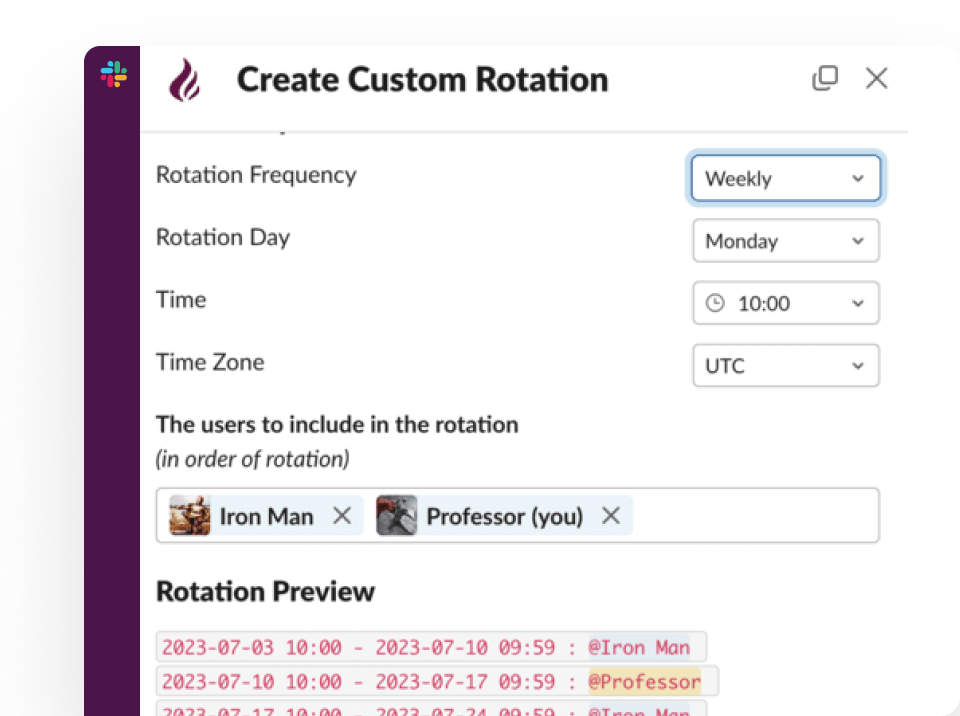
Pagerly offers per-team pricing rather than per-user pricing, which fundamentally changes the cost model as teams grow. A team of five pays the same as a team of twenty, making Pagerly dramatically cheaper than PagerDuty at Business plan pricing for any team larger than a few engineers.
| Capability | PagerDuty Business | Pagerly |
|---|---|---|
| On-call scheduling | Yes (web interface) | Yes (Slack-native) |
| Escalation policies | Yes | Yes |
| Slack usergroup sync | No | Yes (automatic) |
| Channel topic auto-updates | No | Yes |
| Managed in Slack | Partial (alerts only) | Yes (full workflow) |
| Google Calendar sync | Limited | Yes |
| Cover request system | Limited | Yes (self-service in Slack) |
| AI-powered rotation creation | No | Yes |
| Task-based round-robin | No | Yes |
| Pricing model | Per user per month | Per team (flat) |
| Cost for 15-engineer team | ~$615/month (Business) | Flat team rate |
When PagerDuty Pricing Is Worth It
PagerDuty's cost is justified for teams that:
- Have more than fifty engineers with complex multi-tier escalation requirements
- Need enterprise SLAs and dedicated customer success management
- Have significant alert volume that benefits from machine learning-based deduplication and correlation
- Operate in regulated industries that require PagerDuty's audit logs and compliance documentation
- Have existing enterprise contracts with Atlassian, Salesforce, or ServiceNow that include PagerDuty bundled at a discount
For teams outside those criteria, particularly small and mid-size engineering teams with fewer than thirty engineers, the per-user cost and configuration overhead of PagerDuty frequently does not match the value delivered.
Evaluating PagerDuty and wondering if the cost is justified? Pagerly offers per-team pricing, Slack-native scheduling, and automatic usergroup sync at a fraction of PagerDuty's Business plan cost for most team sizes. Get started free